Prom Photo Booth Operations: Setup, Staffing & Logistics Guide
Prom Photo Booth Operations Guide: Setup, Staffing & Logistics
Prom photo booth operations require specialized planning to handle 400+ teenagers in formal wear during a 4-hour window, with unique challenges including venue restrictions, high throughput demands, and coordinated logistics across multiple schools on the same weekend.
Table of Contents
- Pre-Event Planning & School Contract Requirements
- Equipment Setup for High-Traffic Prom Events
- Staffing Strategy for 400+ Guest Events
- Managing Print Queues & Digital Delivery Systems
- Post-Event Breakdown & Multi-Venue Logistics
Pre-Event Planning & School Contract Requirements
High school prom contracts differ significantly from wedding bookings. Schools require liability insurance, background checks for staff, and strict adherence to district policies regarding student photography and data collection.
Start your prom season planning in January. Most schools book photo booth services 3-4 months in advance, with contracts requiring specific insurance minimums ($1M general liability is standard). Request venue walk-throughs during school hours to assess power access, load-in restrictions, and backdrop placement options.
Critical contract clauses for prom operations:
| Contract Element | Standard Wedding | Prom Requirement | |------------------|------------------|------------------| | Insurance minimum | $500K general liability | $1M+ with school named | | Staff background checks | Not required | Required for all staff | | Setup window | 1-2 hours flexible | 30-45 minutes strict | | Student photo consent | N/A | Must use school's forms | | Equipment restrictions | Open | No strobe lights, volume limits |
School districts often require vendors to complete annual registration processes including W-9 forms, certificate of insurance updates, and facility use agreements. Budget 2-3 hours of administrative work per school district beyond your normal booking process.
Coordinate with school event planners on timeline restrictions. Many venues require complete breakdown within 30 minutes of prom end time, creating tight logistics for operators running multiple events the same evening.
Equipment Setup for High-Traffic Prom Events
Prom photo booth setup prioritizes speed and durability over elaborate backdrops. Your equipment must handle 70+ groups per hour during peak periods (typically 8:30-10:30 PM) while maintaining consistent photo quality under challenging venue lighting.
Essential prom equipment configuration:
- Lighting: LED panel arrays instead of strobes (many schools ban flash photography). Budget $800-1,200 for professional LED panels that work in ballroom lighting
- Backdrop: Tension fabric systems that setup in under 10 minutes. Avoid elaborate balloon walls or installations requiring extensive assembly time
- Camera setup: DSLR with 50mm lens for consistent group shots. Auto-focus speed is critical with large groups moving quickly
- Tablet/interface: Large screen (12"+ iPad Pro) with simplified UI. Teenagers gravitate toward AI effects, with 85% choosing enhanced backgrounds over traditional prints
Position your booth near the venue entrance but away from the dance floor. This captures guests during arrival excitement while avoiding sound interference from DJ equipment. Request dedicated 20-amp power circuits to prevent brownouts during peak usage periods.
Pro setup timeline for prom events:
- 60 minutes before: Complete backdrop and lighting setup
- 45 minutes before: Camera calibration and test shots
- 30 minutes before: Staff briefing and queue management setup
- 15 minutes before: Final lighting adjustments and go-live
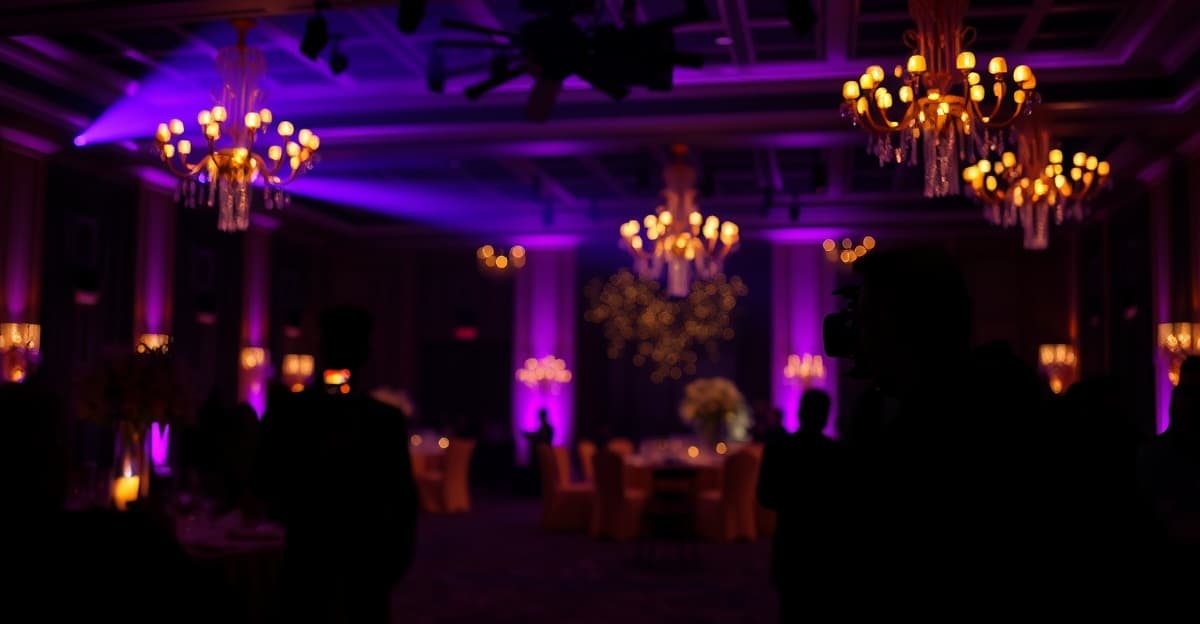
Test your entire system with venue lighting at full brightness. Ballroom chandeliers create challenging mixed-lighting scenarios that require custom white balance settings.
Staffing Strategy for 400+ Guest Events
Prom events require minimum 2-person crews to manage throughput and crowd control effectively. Single-operator setups create bottlenecks that lead to 50+ person lines and frustrated students posting negative reviews on social media.
Optimal prom staffing structure:
- Lead operator: Manages camera, lighting adjustments, and technical troubleshooting
- Queue manager: Organizes groups, manages props, handles crowd control and maintains energy
- Optional third: Print station attendant for high-volume print packages (300+ prints expected)
Your queue manager role is critical for prom success. Teenagers arrive in large friend groups (8-12 people) that need organization into photo-ready arrangements. Train staff on group management techniques including splitting oversized groups and suggesting pose variations that work for formal wear.
Budget $150-200 per additional staff member for prom events. The investment pays for itself through higher guest satisfaction scores and referral bookings from school administrators.
Staff briefing checklist for prom operations:
- School-specific rules (no inappropriate poses, volume limits, etc.)
- Emergency contact information for school chaperones
- Digital delivery timeline and process explanation
- Crowd management techniques for peak periods
- Equipment backup procedures for technical failures
Schedule staff arrival 90 minutes before event start. This allows setup completion with buffer time for last-minute venue changes or technical issues.
Managing Print Queues & Digital Delivery Systems
Prom photo booth operations generate 200-400 prints per event, requiring dedicated print queue management to prevent bottlenecks that kill event energy. Modern thermal printers handle this volume, but organization systems separate successful operators from overwhelmed ones.
Implement numbered ticket systems for print pickup. Groups receive tickets matching their photo session numbers, preventing confusion and reducing staff time spent matching prints to guests. Position print pickup stations away from active photo areas to maintain traffic flow.
Digital delivery optimization for prom events:
| Delivery Method | Guest Adoption Rate | Operator Workload | |-----------------|-------------------|-------------------| | QR code instant download | 65-80% | Minimal | | Text message gallery link | 45-60% | Moderate setup | | Email gallery (next day) | 30-45% | High follow-up | | Social media integration | 80-90% | Minimal |
QR codes printed on photo strips drive highest digital engagement. Students scan codes immediately for Instagram sharing, with share rates reaching 40% compared to 15% for traditional photo booth experiences.
Configure your digital delivery system for mobile optimization. 90% of prom guests access galleries on smartphones, requiring fast-loading thumbnail views and one-tap sharing to Instagram Stories and Snapchat.
Print queue management best practices:
- Dedicate one staff member solely to print organization during peak hours
- Use clear numbering systems visible from queue line
- Batch print every 15-20 photos to maintain consistent flow
- Stock extra printer paper (budget 25% overage for prom events)
Set up backup printing solutions. Printer jams during peak prom hours create cascading delays that impact guest satisfaction and your ability to serve other groups effectively.
Post-Event Breakdown & Multi-Venue Logistics
Prom season requires operators to manage 3-5 events per weekend across different venues, making efficient breakdown and transportation logistics critical for profitability. Most operators charge $1,400-2,500 per prom event, but tight scheduling windows limit your ability to maximize bookings without systematic processes.
Breakdown timeline for prom operations:
- 10 minutes: Secure and pack camera equipment, memory cards
- 15 minutes: Disassemble backdrop and lighting (practice this sequence)
- 10 minutes: Load equipment into transport vehicle
- 5 minutes: Final venue walkthrough and key return
Invest in wheeled equipment cases and modular backdrop systems. Rolling cases reduce breakdown time by 40% compared to traditional hard cases, critical when you have 45 minutes between prom end and next venue setup.
Multi-venue logistics planning:
Create detailed route maps between venues with realistic drive times including Saturday night traffic. Buffer 15-20 minutes beyond GPS estimates for parking and venue access at second locations. Many operators underestimate urban venue access times, leading to delayed setups and stressed staff.
Coordinate with school contacts on flexible breakdown timing. Some venues allow equipment to remain until Sunday morning for additional fees ($50-100), worth paying when you have back-to-back bookings or long transport distances.
Equipment inventory management for prom season:
- Maintain backup camera bodies and lenses for each crew
- Stock 2x normal backdrop inventory (wear and tear increases)
- Prepare emergency lighting solutions for venue power issues
- Keep detailed checklists for each venue's specific requirements
Schedule post-event photo processing during Sunday morning downtime. Prom guests expect digital galleries within 24-48 hours, faster than typical wedding timelines. [INTERNAL:photo-booth-software-comparison] can help streamline your processing workflow during busy prom season.
Successful prom operations require treating each event as part of a larger logistical system rather than individual bookings. Operators who master multi-venue coordination often book 15-20 prom events per season, generating $25,000-40,000 in revenue during the 6-week prom window. Platforms like Alive help streamline the technical aspects of prom photo booth operations with automated processing and mobile-optimized galleries that match teenage social media habits.
Frequently Asked Questions
Try Alive for your next event
Create unforgettable photo experiences with AI-powered photo booth software.
Get Started